今回の記事は前回の
gogowaten.hatenablog.com
↑この記事を書き直したもので
直した理由は速度比較をしていたんだけど、Math.Powの使い所が間違っていて、速度比較になっていないことが記事を書いた6日後に
gogowaten.hatenablog.com
わかったから、なので前回のコードからMathPowを一掃して最初から計測し直しただけなので、内容的にはほとんど同じ
分散の求め方は二通りあるようで
mathtrain.jp
こちらを参考にした
分散その1 = 偏差の2乗の平均(偏差は平均との差のこと)
分散その2 = 2乗の平均 - 平均の2乗
分散その1

{20, 21, 7, 12}
っていう4個の要素のデータ、これの分散は33.5
エクセル2007だとVARPっていう関数で求めることができる
分散 = 偏差の2乗の平均値
偏差 = 各要素と平均値との差
分散 = 各要素と平均値との差の2乗の平均値
データの平均値
{20, 21, 7, 12}の平均値
(20+21+7+12) / 4
= 15
偏差
{20, 21, 7, 12}の各偏差は(各要素 - 平均値)なので
{20-15, 21-15, 7-15, 12-15}
= {5, 6, -8, -3}
偏差の2乗
{5*5, 6*6, -8*-8, -3*-3}
= {25, 36, 64, 9}
分散は偏差の2乗の平均値
(25+36+64+9) / 4
= 33.5
分散その2
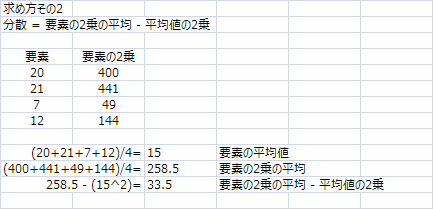
要素の2乗の平均は、(20*20+21*21+7*7+12*12)/4=258.5
平均の2乗は、平均が(20+21+7+12)/4=15、これを2乗して15*15=225
要素の2乗の平均 - 平均の2乗は、258.5-225=33.5
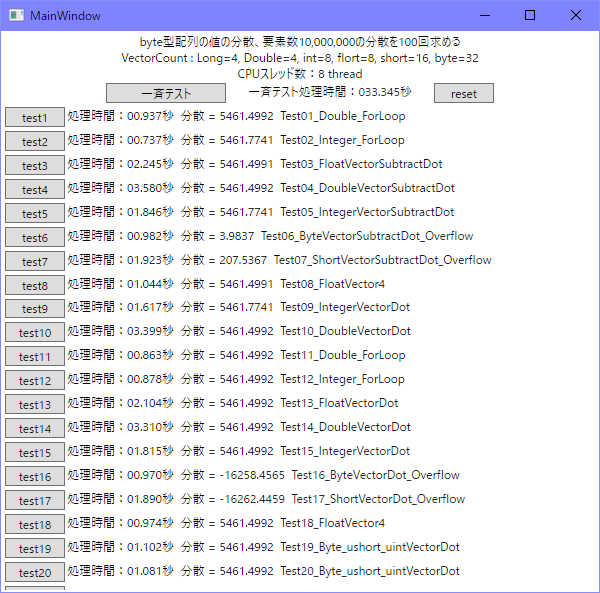
要素数1千万のbyte型配列の分散を100回求める処理時間計測
配列の値はアプリ起動時にランダムなのを入れるので、分散の結果は起動ごとに変わる
前回の記事との違いは
- Test01とTest11で使っていたMathPowをやめて、普通の掛け算にした
- それによって速くなったので配列の要素数を10倍にした、100万→1千万
- 一斉テストボタンを追加した
アプリの制作と計測環境
.NET Frameworkだと参照の追加とかあってめんどくさいけど、.NET Coreならラク
アプリのダウンロード先とコードはギットハブ
ファイル名:20200210_配列の分散、VectorDot_v1.1.zip
github.com
計測結果をグラフで
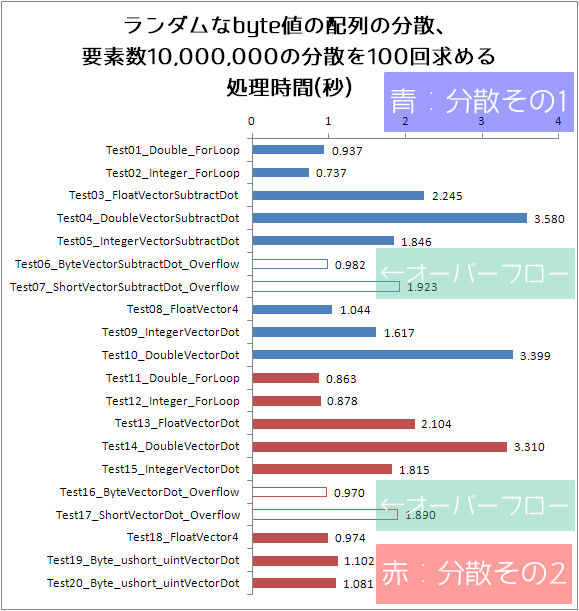
一覧
| Test |
分散 |
精度 |
Vector型 |
速度 |
|
| Test01 |
その1 |
小数点 |
|
1.00 |
Vectorを使わない普通の計算をしているこれ基準にして比較 |
| Test02 |
その1 |
整数 |
|
1.27 |
最速、整数計算だから精度が落ちるけど要素数が多いので誤差 |
| Test03 |
その1 |
小数点 |
float |
0.42 |
偏差とドット積をVectorを使って計算、Vector自体は速いはずだけど準備に時間かかって遅い |
| Test04 |
その1 |
小数点 |
double |
0.26 |
↑とほぼ同じ |
| Test05 |
その1 |
整数 |
int |
0.51 |
↑とほぼ同じ |
| Test06 |
その1 |
破綻 |
byte |
0.95 |
偏差とトッド積の計算でオーバーフローなので求めることができない |
| Test07 |
その1 |
破綻 |
short |
0.49 |
↑とほぼ同じ |
| Test08 |
その1 |
小数点 |
Vector4 |
0.90 |
Vectorのなかでは速いけど普通の計算のほうが速い |
| Test09 |
その1 |
整数 |
int |
0.58 |
偏差は普通に計算してドット積だけVector.Dot |
| Test10 |
その1 |
小数点 |
double |
0.28 |
↑とほぼ同じ |
| Test11 |
その2 |
小数点 |
|
1.09 |
ここからその2で計算、Test01の改変だけど少し速くなった |
| Test12 |
その2 |
小数点 |
|
1.07 |
Test02をその2にした、遅くなったけど精度は上 |
| Test13 |
その2 |
小数点 |
float |
0.45 |
Test03をその2にした、速度は0.42から微増 |
| Test14 |
その2 |
小数点 |
double |
0.28 |
Test04をその2にした、速度は0.26から微増 |
| Test15 |
その2 |
小数点 |
int |
0.52 |
Test05をその2にした、速度は0.51から微増 |
| Test16 |
その2 |
破綻 |
byte |
0.97 |
Test06をその2にした、速度は0.95から微増 |
| Test17 |
その2 |
破綻 |
short |
0.50 |
Test07をその2にした、速度は0.49から微増 |
| Test18 |
その2 |
小数点 |
Vector4 |
0.96 |
Test08をその2にした、速度は0.90から微増 |
| Test19 |
その2 |
小数点 |
uint |
0.85 |
VectorのWidenメソッドでVector<byte>をushort→uintにして計算Vectorのなかでは速いけど |
| Test20 |
その2 |
小数点 |
uint |
0.87 |
↑の変数の使い方を少し変えただけ、意味なかった |
残念ながらVectorを使わないほうが速いという結果になった、けどAVXが強いIntelのCPUやZen2コアになってAVXが強化されたAMD RyzenならVectorのほうが速いかも?
使うとしたら最速のTest02、精度が気になるならTest11かTest12かな、Vectorの出番はない。
分散の求め方その1とその2の比較では、ほんの少しだけどその2のほうが速い
要素数1千万、これは写真撮影に使っているスマカメの画素数が800万だから、これに近い切りのいい数字を選んだ。画像処理で使う予定だから配列の型もbyte型にした。
平均値は先に計算しておいた
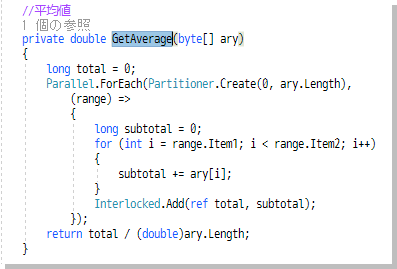
ParallelForEachとPartitionerを使ったマルチスレッドは前回の方法
gogowaten.hatenablog.com
アプリ起動時にこれで計算して
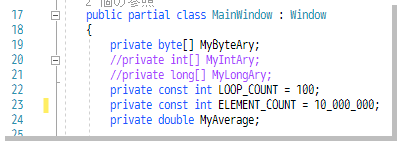
MyAveargeって名前つけたフィールドに置いておいて使うことにした
速度の基準にするTest01は普通の掛け算
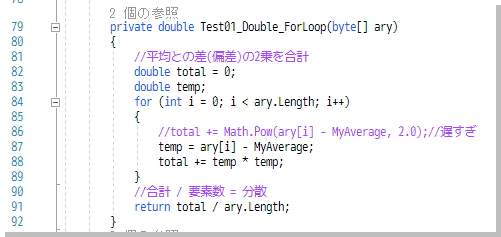
前回はべき乗計算でMathPowを使っていたけど、普通の掛け算にした、これだけで30倍以上速くなった、これのせいで記事を書き直す羽目になった
Test02は偏差の引き算をint型
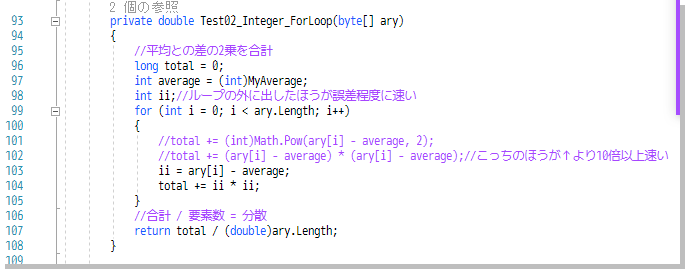
double型で計算していたTest01をint型で計算するようにしたTest02、精度を少し犠牲にして少し速度アップ。前回もここではMathPowを使わないほうが速いことに気づいていたんだけど、このときはint型で計算したために速くなったと思っていた
System.Numerics.Vector.Dotメソッド
System.NumericsはCPUのSIMDを使って計算するクラスがいっぱい

ドット積はググってみたけどよくわからん

2つの同じ要素数の配列(ベクトル?)の各値を掛け算して、それを合計することみたい。掛け算して足し算
配列1{1, 3, 5, 7}
配列2{16, 8, 2, 4}
この2つの配列のドット積は78
各要素同士の掛け算
{1*16, 3*8, 5*2, 7*4} = {16,24,10,28}
合計
{16+24+10+28} = 78
ドット積は78
Dotメソッドを使ってみると

期待通りの値78が返ってきた
分散は偏差の2乗の平均、このうち偏差の2乗は掛け算だし、平均を求めるときには合計する。つまり掛け算して足し算、これはドット積(Dotメソッド)と同じ!
Vector<float>を使ったTest03
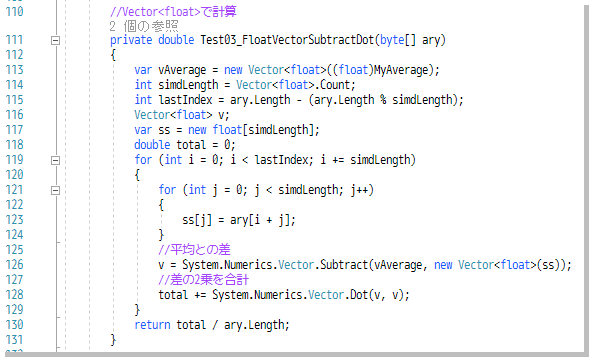
偏差(平均値との差)はVector.Subtract、ドット積はVector.Dotを使った計算

今の環境でVector<float>.Countは8、1回で8個同時に計算できるから、Vectorの計算自体は速いはずだけど、121行目から124行目でVector用の配列を作るのに時間がかかって全体では遅くなるみたいで、処理速度は基準の0.42倍、2倍以上時間がかかる
このTest03、04、05までは型が違うだけで同じ傾向
あと、今回もVectorでの計算は少し問題があって、VectorはVectorCountの値の要素数ごとにしか計算できないから、全要素数がVectorCountで割り切れなかった場合、この余りは別に計算しないと正しい値にならないんだけど、めんどくさいので今回は計算していない例えば全要素数が10000でVectorCountが6だと、10000%6=4で、この4個の余りは計算していない
Test06はVector<byte>で計算してオーバーフロー
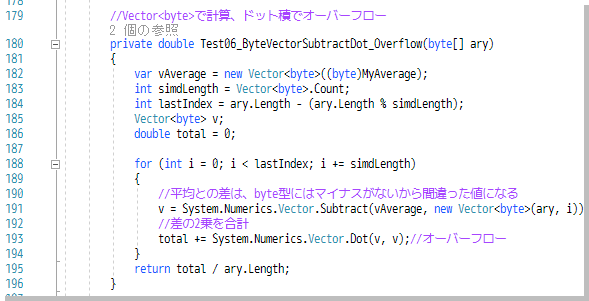
もとの配列の型と同じbyte型だから、新たに配列を作成する必要がない分速いけど、byte型にマイナスの値がないから偏差でオーバーフロー、ドット積でもオーバーフローで間違った値になる。配列から直接Vectorを作ったら速いんじゃないかなあと思ったんだけど、速度は基準の0.95倍、Vector<byte>は32個同時に計算だからもっと速くなってもいいと思うんだけどねえ
Vector.Dotは同じ型で返すからすぐオーバーフローする

byte型VectorでのDotはbyte型で返す、今の環境ではbyte型Vectorは一度に32個を計算するから、かんたんにbyte型の最大値255を超えてしまう
偏差が全部たったの3だったとしてもドット積は288になってしまう、3*3=9、これが32個だから、9*32=288
これがあるからもとの配列の型がbyte型でも、longやdoubleの配列に変換してVector<long>やVector<double>にして計算する必要がある、その変換が時間かかってトータルではVectorを使わないほうが速いってなるんだけど、使い方あるのかしらねえ
Test11、ここからは分散の求め方その2
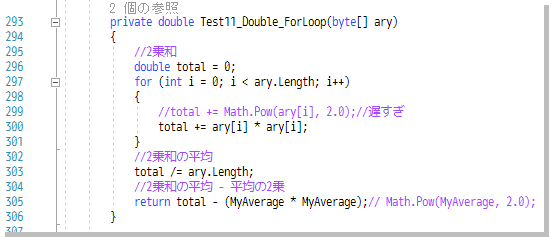
求め方その1だったTest01をその2にしたのがこのTest11、前回記事ではここでもMathPowを使っていたので今回は掛け算に変更したことで30倍以上速くなった。299行目だったのを300行目に変更
使うならこのTest11と次のTest12、速くて精度も高いし、書く文字数も少なくて済む
Test12
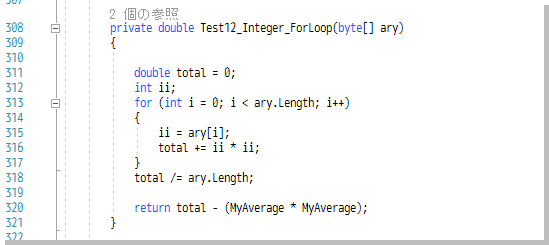
Test02をその2にしただけ、ing型での計算だけどbyte型はもともと整数だから、2乗和の集計の変数の型はlongのほうが良かったかもって今思った、これはTest11でもそうだなあ
Vectorでその2
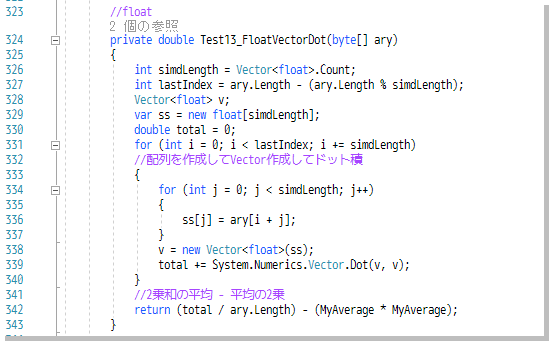
Test03をその2にしただけ
Vector4
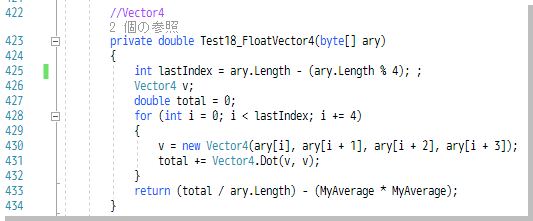
一度に計算できる要素数は4個、型はfloatと決まっているけどVectorの中では最速
Vector.Widen

拡大変換
1つのVector<byte>を2つのVector<ushort>に変換
1つのVector<ushort>なら2つのVector<uint>に変換
とかできる
できないのは符号付きから符号なしの型やその逆、整数型から小数点型やその逆とかはできない、残念
それでもbyteからuintまで変換できればオーバーフローしなくなるので、これを使ったのがTest19と20

変換が多いから遅くなりそうだったけどVectorを使った中では速いほう
<Window xClass="_20200210_配列の分散_VectorDot.MainWindow"
xmlns="http://schemas.microsoft.com/winfx/2006/xaml/presentation"
xmlnsx="http://schemas.microsoft.com/winfx/2006/xaml"
xmlnsd="http://schemas.microsoft.com/expression/blend/2008"
xmlnsmc="http://schemas.openxmlformats.org/markup-compatibility/2006"
xmlnslocal="clr-namespace:_20200210_配列の分散_VectorDot"
mcIgnorable="d"
Title="MainWindow" Height="600" Width="614">
<Grid>
<StackPanel>
<StackPanelResources>
<Style TargetType="StackPanel">
<Setter Property="Margin" Value="2"/>
</Style>
<Style TargetType="Button">
<Setter Property="Width" Value="60"/>
</Style>
<Style TargetType="TextBlock">
<Setter Property="Margin" Value="2,0"/>
</Style>
</StackPanelResources>
<TextBlock xName="MyTextBlock" Text="text" HorizontalAlignment="Center"/>
<TextBlock xName="MyTextBlockVectorCount" Text="vectorCount" HorizontalAlignment="Center"/>
<TextBlock xName="MyTextBlockCpuThreadCount" Text="threadCount" HorizontalAlignment="Center"/>
<StackPanel Orientation="Horizontal" HorizontalAlignment="Center">
<Button xName="ButtonAll" Content="一斉テスト" Margin="20,0" Width="120"/>
<TextBlock xName="TbAll" Text="time"/>
<Button xName="ButtonReset" Content="reset" Margin="20,0"/>
</StackPanel>
<StackPanel Orientation="Horizontal">
<Button xName="Button1" Content="test1"/>
<TextBlock xName="Tb1" Text="time"/>
</StackPanel>
<StackPanel Orientation="Horizontal">
<Button xName="Button2" Content="test2"/>
<TextBlock xName="Tb2" Text="time"/>
</StackPanel>
<StackPanel Orientation="Horizontal">
<Button xName="Button3" Content="test3"/>
<TextBlock xName="Tb3" Text="time"/>
</StackPanel>
<StackPanel Orientation="Horizontal">
<Button xName="Button4" Content="test4"/>
<TextBlock xName="Tb4" Text="time"/>
</StackPanel>
<StackPanel Orientation="Horizontal">
<Button xName="Button5" Content="test5"/>
<TextBlock xName="Tb5" Text="time"/>
</StackPanel>
<StackPanel Orientation="Horizontal">
<Button xName="Button6" Content="test6"/>
<TextBlock xName="Tb6" Text="time"/>
</StackPanel>
<StackPanel Orientation="Horizontal">
<Button xName="Button7" Content="test7"/>
<TextBlock xName="Tb7" Text="time"/>
</StackPanel>
<StackPanel Orientation="Horizontal">
<Button xName="Button8" Content="test8"/>
<TextBlock xName="Tb8" Text="time"/>
</StackPanel>
<StackPanel Orientation="Horizontal">
<Button xName="Button9" Content="test9"/>
<TextBlock xName="Tb9" Text="time"/>
</StackPanel>
<StackPanel Orientation="Horizontal">
<Button xName="Button10" Content="test10"/>
<TextBlock xName="Tb10" Text="time"/>
</StackPanel>
<StackPanel Orientation="Horizontal">
<Button xName="Button11" Content="test11"/>
<TextBlock xName="Tb11" Text="time"/>
</StackPanel>
<StackPanel Orientation="Horizontal">
<Button xName="Button12" Content="test12"/>
<TextBlock xName="Tb12" Text="time"/>
</StackPanel>
<StackPanel Orientation="Horizontal">
<Button xName="Button13" Content="test13"/>
<TextBlock xName="Tb13" Text="time"/>
</StackPanel>
<StackPanel Orientation="Horizontal">
<Button xName="Button14" Content="test14"/>
<TextBlock xName="Tb14" Text="time"/>
</StackPanel>
<StackPanel Orientation="Horizontal">
<Button xName="Button15" Content="test15"/>
<TextBlock xName="Tb15" Text="time"/>
</StackPanel>
<StackPanel Orientation="Horizontal">
<Button xName="Button16" Content="test16"/>
<TextBlock xName="Tb16" Text="time"/>
</StackPanel>
<StackPanel Orientation="Horizontal">
<Button xName="Button17" Content="test17"/>
<TextBlock xName="Tb17" Text="time"/>
</StackPanel>
<StackPanel Orientation="Horizontal">
<Button xName="Button18" Content="test18"/>
<TextBlock xName="Tb18" Text="time"/>
</StackPanel>
<StackPanel Orientation="Horizontal">
<Button xName="Button19" Content="test19"/>
<TextBlock xName="Tb19" Text="time"/>
</StackPanel>
<StackPanel Orientation="Horizontal">
<Button xName="Button20" Content="test20"/>
<TextBlock xName="Tb20" Text="time"/>
</StackPanel>
<StackPanel Orientation="Horizontal">
<Button xName="Button21" Content="test21"/>
<TextBlock xName="Tb21" Text="time"/>
</StackPanel>
<StackPanel Orientation="Horizontal">
<Button xName="Button22" Content="test22"/>
<TextBlock xName="Tb22" Text="time"/>
</StackPanel>
<StackPanel Orientation="Horizontal">
<Button xName="Button23" Content="test23"/>
<TextBlock xName="Tb23" Text="time"/>
</StackPanel>
<StackPanel Orientation="Horizontal">
<Button xName="Button24" Content="test24"/>
<TextBlock xName="Tb24" Text="time"/>
</StackPanel>
<StackPanel Orientation="Horizontal">
<Button xName="Button25" Content="test25"/>
<TextBlock xName="Tb25" Text="time"/>
</StackPanel>
</StackPanel>
</Grid>
</Window>
using System;
using System.Threading.Tasks;
using System.Windows;
using System.Windows.Controls;
using System.Diagnostics;
using System.Numerics;
using System.Threading;
using System.Collections.Concurrent;
using System.Collections.Generic;
namespace _20200210_配列の分散_VectorDot
{
<summary>
</summary>
public partial class MainWindow : Window
{
private byte[] MyByteAry;
private const int LOOP_COUNT = 100;
private const int ELEMENT_COUNT = 10_000_000;
private double MyAverage;
public MainWindow()
{
InitializeComponent();
MyTextBlock.Text = $"byte型配列の値の分散、要素数{ELEMENT_COUNT.ToString("N0")}の分散を{LOOP_COUNT}回求める";
MyTextBlockVectorCount.Text = $"Vector<long>.Count = {Vector<long>.Count}";
string str = $"VectorCount : Long={Vector<long>.Count}, Double={Vector<double>.Count}, int={Vector<int>.Count}, flort={Vector<float>.Count}, short={Vector<short>.Count}, byte={Vector<byte>.Count}";
MyTextBlockVectorCount.Text = str;
MyTextBlockCpuThreadCount.Text = $"CPUスレッド数:{Environment.ProcessorCount.ToString()} thread";
MyInitialize();
ButtonAll.Click += async (s, e) => await MyExeAll();
ButtonReset.Click += (s, e) => MyReset();
Button1.Click += (s, e) => MyExe(Test01_Double_ForLoop, Tb1, MyByteAry);
Button2.Click += (s, e) => MyExe(Test02_Integer_ForLoop, Tb2, MyByteAry);
Button3.Click += (s, e) => MyExe(Test03_FloatVectorSubtractDot, Tb3, MyByteAry);
Button4.Click += (s, e) => MyExe(Test04_DoubleVectorSubtractDot, Tb4, MyByteAry);
Button5.Click += (s, e) => MyExe(Test05_IntegerVectorSubtractDot, Tb5, MyByteAry);
Button6.Click += (s, e) => MyExe(Test06_ByteVectorSubtractDot_Overflow, Tb6, MyByteAry);
Button7.Click += (s, e) => MyExe(Test07_ShortVectorSubtractDot_Overflow, Tb7, MyByteAry);
Button8.Click += (s, e) => MyExe(Test08_FloatVector4, Tb8, MyByteAry);
Button9.Click += (s, e) => MyExe(Test09_IntegerVectorDot, Tb9, MyByteAry);
Button10.Click += (s, e) => MyExe(Test10_DoubleVectorDot, Tb10, MyByteAry);
Button11.Click += (s, e) => MyExe(Test11_Double_ForLoop, Tb11, MyByteAry);
Button12.Click += (s, e) => MyExe(Test12_Integer_ForLoop, Tb12, MyByteAry);
Button13.Click += (s, e) => MyExe(Test13_FloatVectorDot, Tb13, MyByteAry);
Button14.Click += (s, e) => MyExe(Test14_DoubleVectorDot, Tb14, MyByteAry);
Button15.Click += (s, e) => MyExe(Test15_IntegerVectorDot, Tb15, MyByteAry);
Button16.Click += (s, e) => MyExe(Test16_ByteVectorDot_Overflow, Tb16, MyByteAry);
Button17.Click += (s, e) => MyExe(Test17_ShortVectorDot_Overflow, Tb17, MyByteAry);
Button18.Click += (s, e) => MyExe(Test18_FloatVector4, Tb18, MyByteAry);
Button19.Click += (s, e) => MyExe(Test19_Byte_ushort_uintVectorDot, Tb19, MyByteAry);
Button20.Click += (s, e) => MyExe(Test20_Byte_ushort_uintVectorDot, Tb20, MyByteAry);
}
private void MyInitialize()
{
MyByteAry = new byte[ELEMENT_COUNT];
var r = new Random();
r.NextBytes(MyByteAry);
MyAverage = GetAverage(MyByteAry);
}
private double Test01_Double_ForLoop(byte[] ary)
{
double total = 0;
double temp;
for (int i = 0; i < ary.Length; i++)
{
temp = ary[i] - MyAverage;
total += temp * temp;
}
return total / ary.Length;
}
private double Test02_Integer_ForLoop(byte[] ary)
{
long total = 0;
int average = (int)MyAverage;
int ii;
for (int i = 0; i < ary.Length; i++)
{
ii = ary[i] - average;
total += ii * ii;
}
return total / (double)ary.Length;
}
private double Test03_FloatVectorSubtractDot(byte[] ary)
{
var vAverage = new Vector<float>((float)MyAverage);
int simdLength = Vector<float>.Count;
int lastIndex = ary.Length - (ary.Length % simdLength);
Vector<float> v;
var ss = new float[simdLength];
double total = 0;
for (int i = 0; i < lastIndex; i += simdLength)
{
for (int j = 0; j < simdLength; j++)
{
ss[j] = ary[i + j];
}
v = System.Numerics.Vector.Subtract(vAverage, new Vector<float>(ss));
total += System.Numerics.Vector.Dot(v, v);
}
return total / ary.Length;
}
private double Test04_DoubleVectorSubtractDot(byte[] ary)
{
var vAverage = new Vector<double>(MyAverage);
int simdLength = Vector<double>.Count;
int lastIndex = ary.Length - (ary.Length % simdLength);
Vector<double> v;
var ss = new double[simdLength];
double total = 0;
for (int i = 0; i < lastIndex; i += simdLength)
{
for (int j = 0; j < simdLength; j++)
{
ss[j] = ary[i + j];
}
v = System.Numerics.Vector.Subtract(vAverage, new Vector<double>(ss));
total += System.Numerics.Vector.Dot(v, v);
}
return total / ary.Length;
}
private double Test05_IntegerVectorSubtractDot(byte[] ary)
{
var vAverage = new Vector<int>((int)MyAverage);
int simdLength = Vector<int>.Count;
int lastIndex = ary.Length - (ary.Length % simdLength);
Vector<int> v;
var ss = new int[simdLength];
double total = 0;
for (int i = 0; i < lastIndex; i += simdLength)
{
for (int j = 0; j < simdLength; j++)
{
ss[j] = ary[i + j];
}
v = System.Numerics.Vector.Subtract(vAverage, new Vector<int>(ss));
total += System.Numerics.Vector.Dot(v, v);
}
return total / ary.Length;
}
private double Test06_ByteVectorSubtractDot_Overflow(byte[] ary)
{
var vAverage = new Vector<byte>((byte)MyAverage);
int simdLength = Vector<byte>.Count;
int lastIndex = ary.Length - (ary.Length % simdLength);
Vector<byte> v;
double total = 0;
for (int i = 0; i < lastIndex; i += simdLength)
{
v = System.Numerics.Vector.Subtract(vAverage, new Vector<byte>(ary, i));
total += System.Numerics.Vector.Dot(v, v);
}
return total / ary.Length;
}
private double Test07_ShortVectorSubtractDot_Overflow(byte[] ary)
{
var vAverage = new Vector<short>((short)MyAverage);
int simdLength = Vector<short>.Count;
int lastIndex = ary.Length - (ary.Length % simdLength);
Vector<short> v;
long total = 0;
var ss = new short[simdLength];
for (int i = 0; i < lastIndex; i += simdLength)
{
for (int j = 0; j < simdLength; j++)
{
ss[j] = ary[i + j];
}
v = System.Numerics.Vector.Subtract(vAverage, new Vector<short>(ss));
total += System.Numerics.Vector.Dot(v, v);
}
return (double)total / ary.Length;
}
private double Test08_FloatVector4(byte[] ary)
{
int lastIndex = ary.Length - (ary.Length % 4);
var vAverage = new Vector4((float)MyAverage);
Vector4 v;
double total = 0;
for (int i = 0; i < lastIndex; i += 4)
{
v = Vector4.Subtract(new Vector4(ary[i], ary[i + 1], ary[i + 2], ary[i + 3]), vAverage);
total += Vector4.Dot(v, v);
}
return total / ary.Length;
}
private double Test09_IntegerVectorDot(byte[] ary)
{
int average = (int)MyAverage;
int simdLength = Vector<int>.Count;
int lastIndex = ary.Length - (ary.Length % simdLength);
Vector<int> v;
long total = 0;
int[] ii = new int[simdLength];
for (int i = 0; i < lastIndex; i += simdLength)
{
for (int j = 0; j < simdLength; j++)
{
ii[j] = average - ary[i + j];
}
v = new Vector<int>(ii);
total += System.Numerics.Vector.Dot(v, v);
}
return total / (double)ary.Length;
}
private double Test10_DoubleVectorDot(byte[] ary)
{
int simdLength = Vector<double>.Count;
int lastIndex = ary.Length - (ary.Length % simdLength);
Vector<double> v;
double total = 0;
double[] ii = new double[simdLength];
for (int i = 0; i < lastIndex; i += simdLength)
{
for (int j = 0; j < simdLength; j++)
{
ii[j] = MyAverage - ary[i + j];
}
v = new Vector<double>(ii);
total += System.Numerics.Vector.Dot(v, v);
}
return total / ary.Length;
}
#region 分散 = 2乗和の平均 - 平均の2乗
private double Test11_Double_ForLoop(byte[] ary)
{
double total = 0;
for (int i = 0; i < ary.Length; i++)
{
total += ary[i] * ary[i];
}
total /= ary.Length;
return total - (MyAverage * MyAverage);
}
private double Test12_Integer_ForLoop(byte[] ary)
{
double total = 0;
int ii;
for (int i = 0; i < ary.Length; i++)
{
ii = ary[i];
total += ii * ii;
}
total /= ary.Length;
return total - (MyAverage * MyAverage);
}
private double Test13_FloatVectorDot(byte[] ary)
{
int simdLength = Vector<float>.Count;
int lastIndex = ary.Length - (ary.Length % simdLength);
Vector<float> v;
var ss = new float[simdLength];
double total = 0;
for (int i = 0; i < lastIndex; i += simdLength)
{
for (int j = 0; j < simdLength; j++)
{
ss[j] = ary[i + j];
}
v = new Vector<float>(ss);
total += System.Numerics.Vector.Dot(v, v);
}
return (total / ary.Length) - (MyAverage * MyAverage);
}
private double Test14_DoubleVectorDot(byte[] ary)
{
int simdLength = Vector<double>.Count;
int lastIndex = ary.Length - (ary.Length % simdLength);
Vector<double> v;
var ss = new double[simdLength];
double total = 0;
for (int i = 0; i < lastIndex; i += simdLength)
{
for (int j = 0; j < simdLength; j++)
{
ss[j] = ary[i + j];
}
v = new Vector<double>(ss);
total += System.Numerics.Vector.Dot(v, v);
}
return (total / ary.Length) - (MyAverage * MyAverage);
}
private double Test15_IntegerVectorDot(byte[] ary)
{
int simdLength = Vector<int>.Count;
int lastIndex = ary.Length - (ary.Length % simdLength);
Vector<int> v;
var ss = new int[simdLength];
double total = 0;
for (int i = 0; i < lastIndex; i += simdLength)
{
for (int j = 0; j < simdLength; j++)
{
ss[j] = ary[i + j];
}
v = new Vector<int>(ss);
total += System.Numerics.Vector.Dot(v, v);
}
return (total / ary.Length) - (MyAverage * MyAverage);
}
private double Test16_ByteVectorDot_Overflow(byte[] ary)
{
int simdLength = Vector<byte>.Count;
int lastIndex = ary.Length - (ary.Length % simdLength);
Vector<byte> v;
double total = 0;
for (int i = 0; i < lastIndex; i += simdLength)
{
v = new Vector<byte>(ary, i);
total += System.Numerics.Vector.Dot(v, v);
}
return (total / ary.Length) - (MyAverage * MyAverage);
}
private double Test17_ShortVectorDot_Overflow(byte[] ary)
{
int simdLength = Vector<short>.Count;
int lastIndex = ary.Length - (ary.Length % simdLength);
Vector<short> v;
long total = 0;
var ss = new short[simdLength];
for (int i = 0; i < lastIndex; i += simdLength)
{
for (int j = 0; j < simdLength; j++)
{
ss[j] = ary[i + j];
}
v = new Vector<short>(ss);
total += System.Numerics.Vector.Dot(v, v);
}
return (total / ary.Length) - (MyAverage * MyAverage);
}
private double Test18_FloatVector4(byte[] ary)
{
int lastIndex = ary.Length - (ary.Length % 4); ;
Vector4 v;
double total = 0;
for (int i = 0; i < lastIndex; i += 4)
{
v = new Vector4(ary[i], ary[i + 1], ary[i + 2], ary[i + 3]);
total += Vector4.Dot(v, v);
}
return (total / ary.Length) - (MyAverage * MyAverage);
}
private double Test19_Byte_ushort_uintVectorDot(byte[] ary)
{
int simdLength = Vector<byte>.Count;
int lastIndex = ary.Length - (ary.Length % simdLength);
Vector<byte> v;
double total = 0;
Vector<ushort> v1; Vector<ushort> v2;
Vector<uint> vv1; Vector<uint> vv2; Vector<uint> vv3; Vector<uint> vv4;
for (int i = 0; i < lastIndex; i += simdLength)
{
v = new Vector<byte>(ary, i);
System.Numerics.Vector.Widen(v, out v1, out v2);
System.Numerics.Vector.Widen(v1, out vv1, out vv2);
System.Numerics.Vector.Widen(v2, out vv3, out vv4);
total += System.Numerics.Vector.Dot(vv1, vv1);
total += System.Numerics.Vector.Dot(vv2, vv2);
total += System.Numerics.Vector.Dot(vv3, vv3);
total += System.Numerics.Vector.Dot(vv4, vv4);
}
return (total / ary.Length) - (MyAverage * MyAverage);
}
private double Test20_Byte_ushort_uintVectorDot(byte[] ary)
{
int simdLength = Vector<byte>.Count;
int lastIndex = ary.Length - (ary.Length % simdLength);
Vector<byte> v;
double total = 0;
for (int i = 0; i < lastIndex; i += simdLength)
{
v = new Vector<byte>(ary, i);
System.Numerics.Vector.Widen(v, out Vector<ushort> v1, out Vector<ushort> v2);
System.Numerics.Vector.Widen(v1, out Vector<uint> vv1, out Vector<uint> vv2);
System.Numerics.Vector.Widen(v2, out Vector<uint> vv3, out Vector<uint> vv4);
total += System.Numerics.Vector.Dot(vv1, vv1);
total += System.Numerics.Vector.Dot(vv2, vv2);
total += System.Numerics.Vector.Dot(vv3, vv3);
total += System.Numerics.Vector.Dot(vv4, vv4);
}
return (total / ary.Length) - (MyAverage * MyAverage);
}
#endregion
private async Task MyExeAll()
{
this.IsEnabled = false;
var sw = new Stopwatch();
sw.Start();
await Task.Run(() => MyExe(Test01_Double_ForLoop, Tb1, MyByteAry));
await Task.Run(() => MyExe(Test02_Integer_ForLoop, Tb2, MyByteAry));
await Task.Run(() => MyExe(Test03_FloatVectorSubtractDot, Tb3, MyByteAry));
await Task.Run(() => MyExe(Test04_DoubleVectorSubtractDot, Tb4, MyByteAry));
await Task.Run(() => MyExe(Test05_IntegerVectorSubtractDot, Tb5, MyByteAry));
await Task.Run(() => MyExe(Test06_ByteVectorSubtractDot_Overflow, Tb6, MyByteAry));
await Task.Run(() => MyExe(Test07_ShortVectorSubtractDot_Overflow, Tb7, MyByteAry));
await Task.Run(() => MyExe(Test08_FloatVector4, Tb8, MyByteAry));
await Task.Run(() => MyExe(Test09_IntegerVectorDot, Tb9, MyByteAry));
await Task.Run(() => MyExe(Test10_DoubleVectorDot, Tb10, MyByteAry));
await Task.Run(() => MyExe(Test11_Double_ForLoop, Tb11, MyByteAry));
await Task.Run(() => MyExe(Test12_Integer_ForLoop, Tb12, MyByteAry));
await Task.Run(() => MyExe(Test13_FloatVectorDot, Tb13, MyByteAry));
await Task.Run(() => MyExe(Test14_DoubleVectorDot, Tb14, MyByteAry));
await Task.Run(() => MyExe(Test15_IntegerVectorDot, Tb15, MyByteAry));
await Task.Run(() => MyExe(Test16_ByteVectorDot_Overflow, Tb16, MyByteAry));
await Task.Run(() => MyExe(Test17_ShortVectorDot_Overflow, Tb17, MyByteAry));
await Task.Run(() => MyExe(Test18_FloatVector4, Tb18, MyByteAry));
await Task.Run(() => MyExe(Test19_Byte_ushort_uintVectorDot, Tb19, MyByteAry));
await Task.Run(() => MyExe(Test20_Byte_ushort_uintVectorDot, Tb20, MyByteAry));
sw.Stop();
this.IsEnabled = true;
TbAll.Text = $"一斉テスト処理時間:{sw.Elapsed.TotalSeconds.ToString("000.000")}秒";
}
private void MyReset()
{
var tbs = GetObjects<TextBlock>(this);
foreach (var item in tbs)
{
item.Text = "";
}
}
private static List<T> GetObjects<T>(DependencyObject obj) where T : DependencyObject
{
var lo = new List<T>();
foreach (var item in LogicalTreeHelper.GetChildren(obj))
{
if (item is T) { lo.Add((T)item); }
if(item is DependencyObject dObj)
{
foreach (var item2 in GetObjects<T>(dObj))
{
lo.Add(item2);
}
}
}
return lo;
}
private double GetAverage(byte[] ary)
{
long total = 0;
Parallel.ForEach(Partitioner.Create(0, ary.Length),
(range) =>
{
long subtotal = 0;
for (int i = range.Item1; i < range.Item2; i++)
{
subtotal += ary[i];
}
Interlocked.Add(ref total, subtotal);
});
return total / (double)ary.Length;
}
private void MyExe(Func<byte[], double> func, TextBlock tb, byte[] ary)
{
double total = 0;
var sw = new Stopwatch();
sw.Start();
for (int i = 0; i < LOOP_COUNT; i++)
{
total = func(ary);
}
sw.Stop();
this.Dispatcher.Invoke(() =>
{
tb.Text = $"処理時間:{sw.Elapsed.TotalSeconds.ToString("00.000")}秒 分散 = {total.ToString("F4")} {System.Reflection.RuntimeReflectionExtensions.GetMethodInfo(func).Name}";
});
}
}
}
次回はマルチスレッドで比較したい
関連記事
次は2日後
8日前
gogowaten.hatenablog.com
